
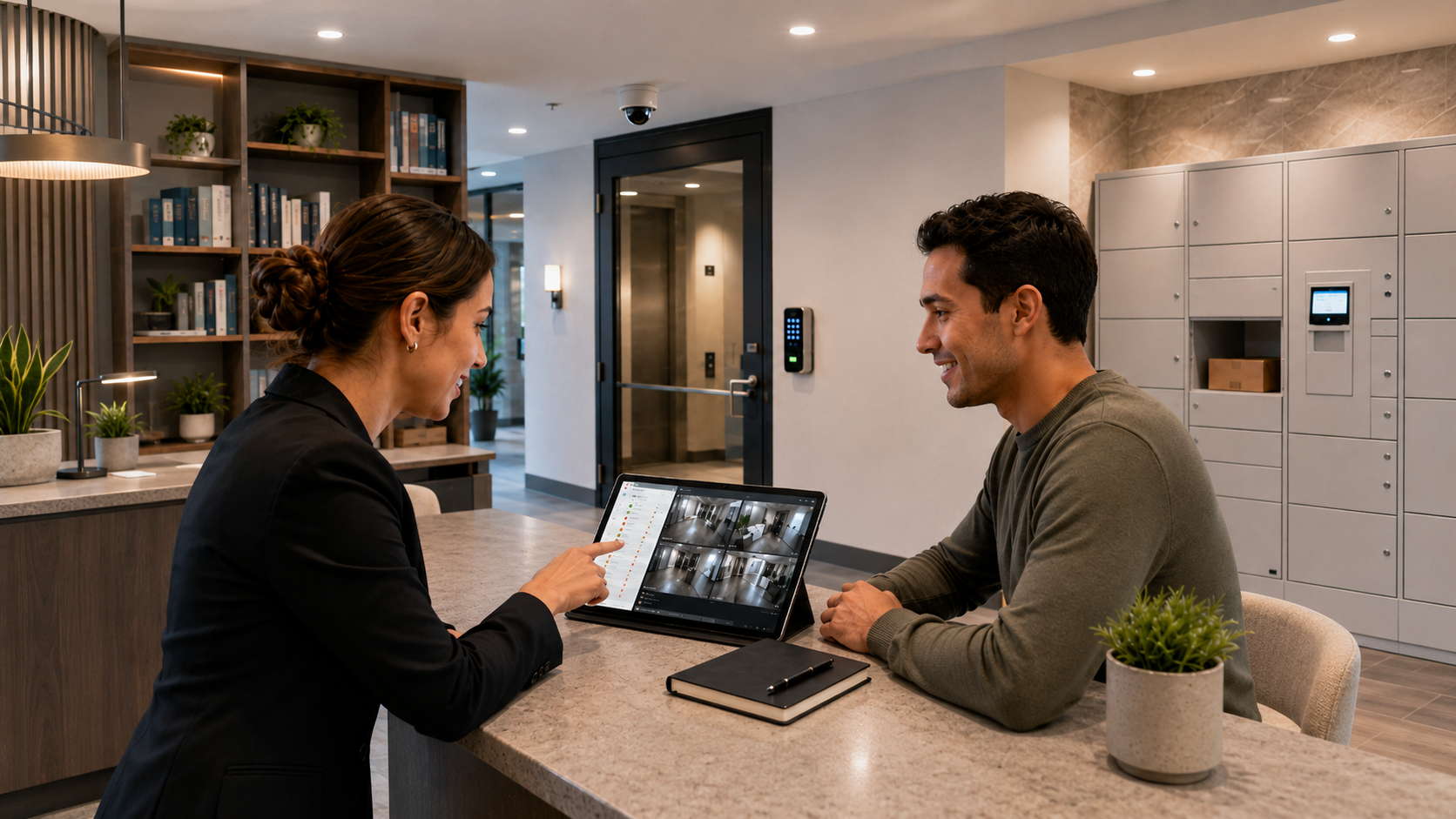
Security incidents are the most common driver of negative online reviews for multifamily properties, and negative reviews are now one of the most direct drivers of occupancy loss. For multifamily operators managing reputation across a portfolio, the connection between access control, surveillance coverage, and star ratings isn't incidental. It's causal.
Before a prospective resident ever schedules a tour, they've read your reviews. Here's what those reviews are actually saying, why security is at the center of it, and what operators can do to reverse the pattern.
What Do Residents Actually Write Negative Reviews About?
Look at one- and two-star reviews for any multifamily property and a pattern emerges quickly. Residents rarely write negative reviews about countertop finishes or carpet color.
They write about feeling unsafe. Specifically:
- Break-ins or attempted break-ins in parking structures
- Strangers in the building who shouldn't have access
- Package theft from lobbies or mail rooms
- Poorly lit common areas and entry points
- Management failing to respond after a security incident
These aren't isolated complaints. They're signals of systemic gaps in access control and surveillance coverage. And they don't stay contained to the review platform. They get shared, screenshotted, and cited by prospective residents during their search.
According to J. Turner Research, properties with lower online reputation scores experience measurably higher vacancy rates, and security-related complaints are consistently among the top drivers of one- and two-star reviews across the multifamily sector.
For portfolio operators, a single property with a persistent security perception problem can pull down the brand across every community.
Do Negative Security Reviews Affect Lease Renewals, Not Just New Leases?
Yes, and the renewal impact is often larger than operators realize.
Residents who feel unsafe don't always file a formal complaint. They post a review, tell their neighbors, and start quietly looking for their next apartment. By the time occupancy starts slipping, the reputational damage is already compounding in public.
The inverse is equally true. Properties where residents feel protected generate a measurably different kind of review, ones that:
- Mention peace of mind and feeling safe at home
- Call out the responsiveness and professionalism of on-site management
- Recommend the community to friends and family
- Reference specific amenities like controlled access and monitored common areas
Security that works quietly—that prevents incidents before they happen—rarely gets called out by name. But it shapes the overall experience residents describe when they sit down to write a review. The absence of problems is itself a five-star signal.
How Does Slow Incident Response Damage Multifamily Reputation?
It's often not the incident itself that generates the worst reviews. It's the lag between the incident and a visible management response.
A resident reports a break-in. Days pass with no update. No visible change to operations. The review gets written from a place of frustration and abandonment, and that emotional context produces the kind of detailed, specific negative content that ranks well on Google and gets read by every prospective resident who searches the property name.
Integrated video, access control, and alarm systems change that dynamic by giving management:
- Footage available for immediate review after an incident
- Access logs that identify exactly who entered and when
- Alarm history that documents the timeline and response
- Specific, factual information to communicate back to residents
The combination of faster response, clearer communication, and visible follow-through is what earns the trust that shows up in reviews. A management team that can say, "Here's what happened, here's what we did, and here's what we changed," is a management team that turns a negative incident into a reputation-building moment.
Is Security a Reputation Strategy, Not Just a Risk Management Strategy?
Yes. And the operators who recognize that distinction have a meaningful competitive advantage.
Most multifamily operators think about security as risk management—liability reduction, incident documentation, regulatory compliance. That framing is correct but incomplete. Security is also a resident experience strategy and, by extension, a reputation strategy.
Properties that invest in controlled building access, intelligent video coverage, and integrated alarm monitoring are investing in the conditions that generate positive reviews, stronger retention, and higher occupancy. The ROI isn't only in prevented incidents. It's in:
- Renewals that don't require a concession to close
- Leads that convert because the reviews hold up under scrutiny
- Reputation scores that make paid acquisition more efficient
- Portfolio-wide brand consistency that compounds across communities
The security infrastructure decision and the reputation management decision are, increasingly, the same decision.
Frequently Asked Questions
What security issues cause the most negative multifamily reviews?
Unauthorized access, package theft, parking structure break-ins, and slow management response after incidents consistently appear as the top security-related drivers of one- and two-star multifamily reviews. Poorly lit common areas and entry points are also frequently cited. Each of these maps to a specific infrastructure gap: access control, surveillance coverage, or alarm and response integration.
How does access control improvement affect online reputation for apartment communities?
By reducing the incidents that generate negative reviews in the first place, and by giving management the tools to respond faster and more specifically when incidents do occur. Residents who see management act decisively after a security concern are significantly more likely to update or moderate a negative review, and to renew their lease.
Can better security infrastructure improve a property's star rating?
Yes, over time and with consistent execution. Reputation recovery is gradual, as existing negative reviews don't disappear, but properties that address underlying security gaps and improve incident response typically see review sentiment shift within two to four lease cycles. The more important dynamic is preventing the next wave of negative reviews while positive experiences accumulate.
What's the relationship between security response time and resident trust?
It's direct and significant. The lag between a security incident and a visible management response is one of the most damaging patterns in multifamily reputation management. Integrated systems, where footage, access logs, and alarm history are immediately accessible, compress that lag dramatically. Faster, more specific responses communicate that management is in control, which is precisely what residents want to see before they decide whether to renew.
How should multifamily operators think about security as an ROI driver?
Beyond incident prevention, the ROI case includes the following: renewals that close without concessions, leads that convert because review scores are strong, reduced marketing spend needed to overcome reputation drag, and portfolio-wide brand consistency that makes each community easier to lease up. Properties with strong security reputations also tend to attract residents who take better care of units, a downstream benefit that affects maintenance costs and turnover expenses.
What's the first step for a multifamily operator who wants to address security-driven reputation problems?
A coverage audit, a site-by-site assessment of where access control gaps exist, where monitored video coverage has blind spots, and where incident response workflows break down. That audit typically surfaces two or three high-priority fixes per property that address the majority of the security complaints appearing in reviews. Starting with the highest-review-impact gaps, rather than a full infrastructure replacement, is the most efficient path to reputation improvement. Closing those gaps usually comes down to intelligent camera coverage across entries, garages, and common areas.
Vitalis Security designs, installs, and supports integrated video, access, and alarm systems built for multifamily operations, so your team can respond faster, protect residents more consistently, and build the kind of reputation that fills units.
Want to assess where your security coverage has gaps?