
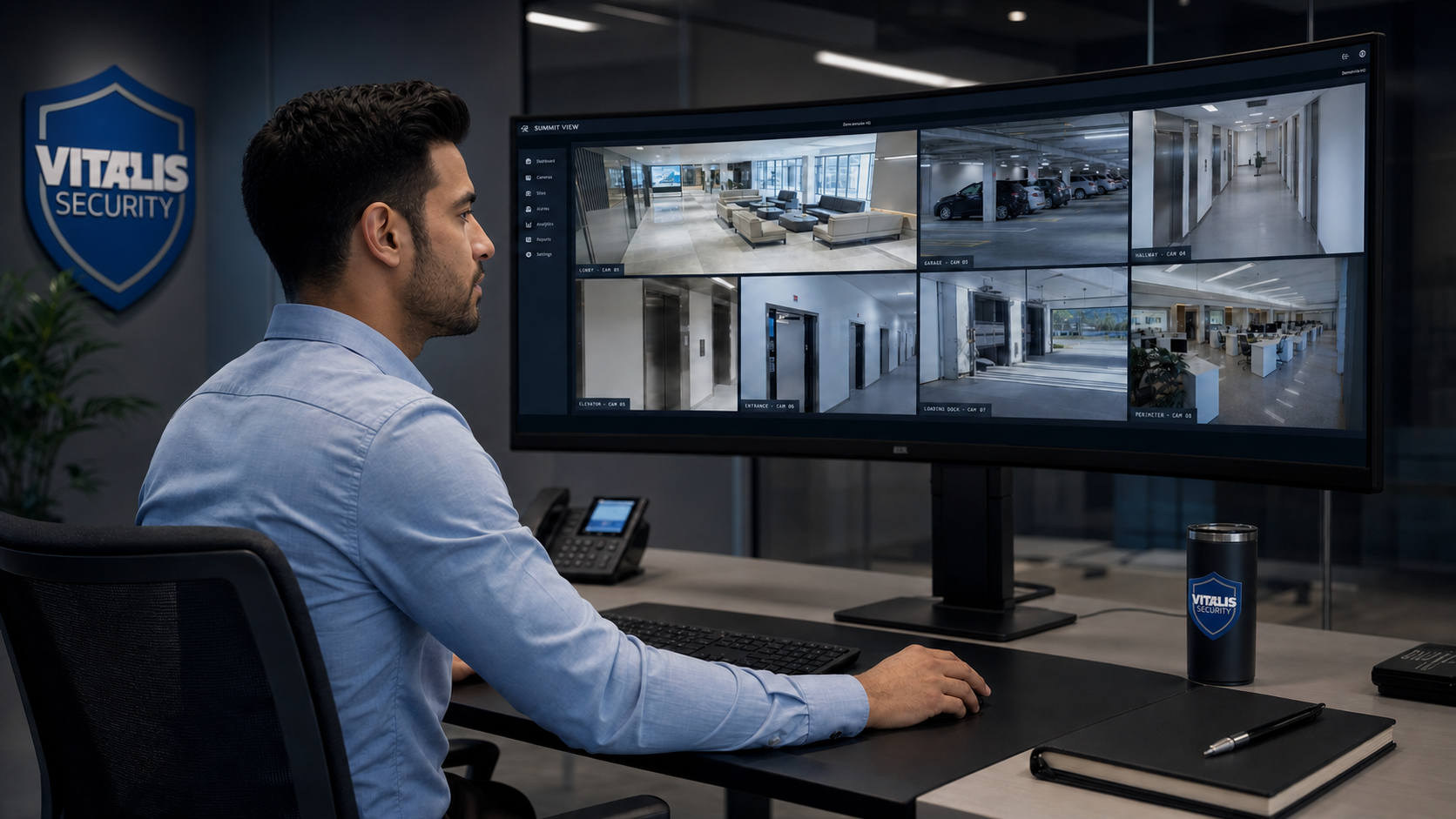
Your security staff can’t be everywhere at once, but your cameras can.
For commercial real estate operators managing office towers, mixed-use campuses, or multi-tenant portfolios, it’s unrealistic to have staff in every corridor, parking structure, loading dock, and lobby around the clock. Intelligent video systems help augment your security team with cameras by closing coverage gaps, improving visibility, and helping personnel respond faster with better information. The goal is not to replace your team, but to make it more effective across the property.
Why Coverage is the Real Security Problem
Most commercial real estate security problems come from gaps in visibility across the property, not simply from having too few people on staff.
A lobby guard can’t monitor the parking garage, loading dock, and rooftop access simultaneously. And reviewing footage after an incident doesn’t undo the delay in detecting it. The cost of under-coverage goes beyond liability: it impacts operations, tenant experience, and property reputation.
Intelligent video extends visibility across your property in real time, helping your team respond faster and with better information.
What It Means to Augment Your Security Team with Cameras
Augmenting your security team with cameras means using intelligent video systems to extend visibility and reach on your properties without adding headcount at every location.
Coverage Without Blind Spots
Coverage without blind spots means designing a camera layout that gives your team clear views of every high-risk and high-traffic area across the property, including:
- Lobbies and entry points
- Parking garages and stairwells
- Loading docks and service corridors
- Shared amenities and common areas
The goal isn’t simply adding more cameras. It’s strategic placement that gives operators a complete view of the property.
How Smarter Alerts Reduce Noise
Smarter alerts reduce noise by filtering out routine motion detection and only notifying your team when video analytics detect activity that needs attention.
Modern AI-driven video surveillance systems reduce the noise by identifying meaningful activity, such as:
- Unauthorized access after hours
- Movement in restricted areas
- Vehicles blocking fire lanes
- Suspicious lingering near entrances
Instead of reacting to every motion event, teams receive only alerts that require attention.
How Remote Monitoring Extends After-Hours Coverage
Remote monitoring extends after-hours coverage by allowing a centralized team or a monitoring partner to watch multiple properties via cameras instead of paying for onsite guards at every building overnight. Here's how remote video monitoring vs overnight guards compares on cost and coverage.
For commercial property owners and managers, this creates:
- Better visibility across all sites
- Faster response to incidents
- Lower staffing costs for after-hours coverage
- One centralized system instead of separate property-level platforms
Why Camera Integration with Access Control Matters
When you integrate cameras with access control, operators can instantly see who triggered an event and respond with context instead of piecing together separate systems.
For example:
- If a door is propped open, the system can automatically display the associated camera feed
- If a credential is used after hours, operators can immediately verify who entered
- Alarm events can trigger video verification in real time
This integrated approach eliminates the need for teams to manually piece together information from disconnected systems.
What to Look for in a Commercial Camera System
Not all video systems are designed for commercial real estate operations. The right commercial camera system should centralize management, scale across your portfolio, integrate with other building systems, and use AI to surface only the events that matter. So, when evaluating video solutions, prioritize:
- Centralized management: One platform for all properties
- Scalability: Ability to support future buildings or expansions
- Integration: Compatibility with access control, visitor management, and building systems
- AI-driven analytics: Alerts that reduce false positives
- Reliable support: Ongoing maintenance and accountability when systems fail
The cameras themselves are only part of the solution. System design, integration, and support matter just as much.
How Intelligent Video Supports Operations
Intelligent video supports operations by turning security footage into real-time, actionable data that improves incident response, documentation, and tenant confidence across your properties.
As security teams are constantly being asked to do more with the same resources, the answer isn’t simply adding headcount: it’s improving visibility and response capabilities.
When intelligent video systems provide real-time alerts, integrated monitoring, and actionable data, teams spend less time reacting to uncertainty and more time managing outcomes. That leads to stronger tenant confidence, better incident documentation, and lower long-term liability exposure.
That’s what it looks like when security becomes a vital part of your operational strategy instead of just another expense.
Vitalis Security designs, installs, and supports integrated video, access control, and alarm systems for commercial real estate operators across multi-site portfolios. To see how cameras can augment your security team without adding headcounts to every building, request a free consultation with our team.