
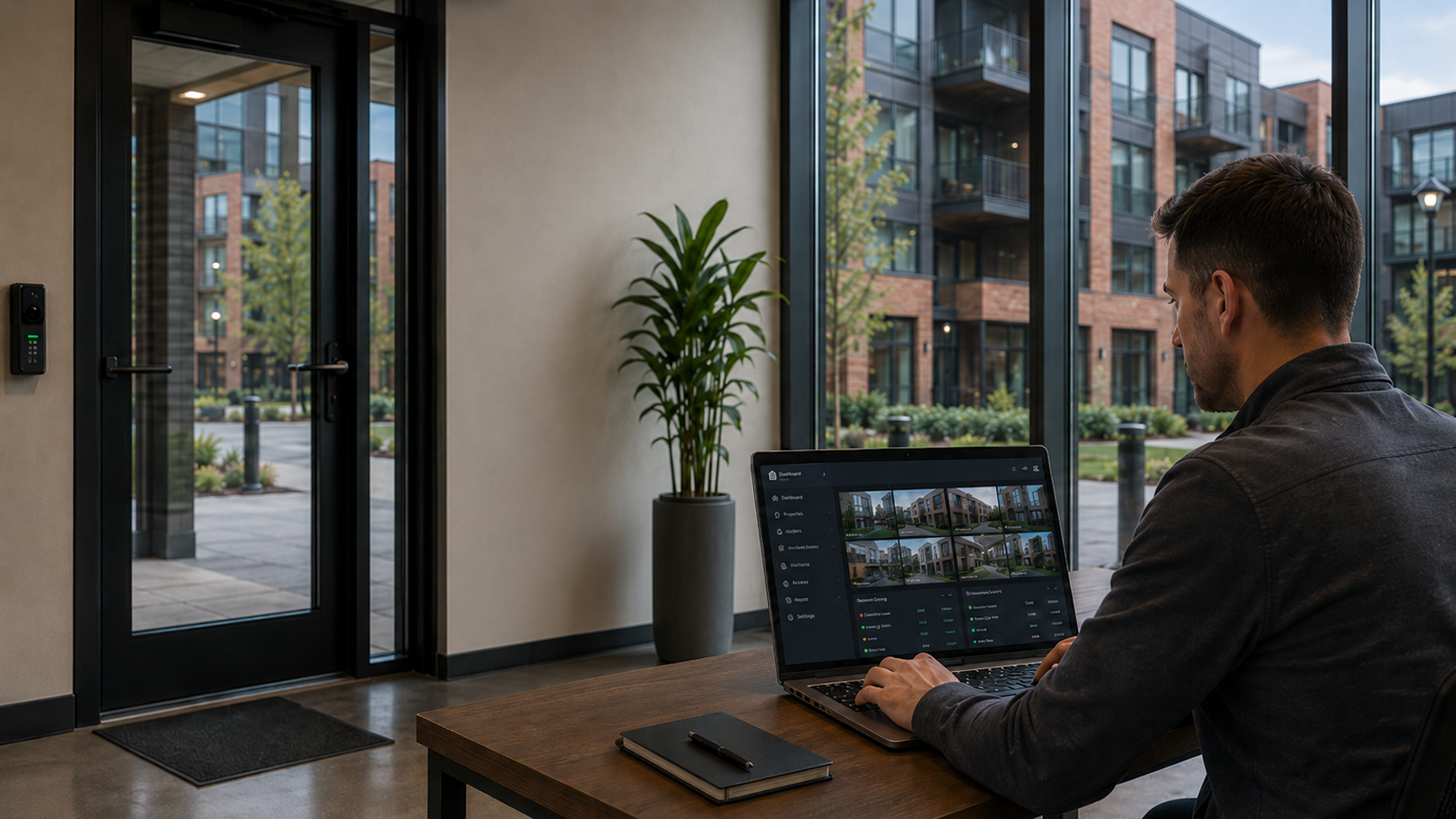
For owners and operators managing more than a handful of communities, fragmented security infrastructure isn't just inconvenient. It's a measurable drag on net operating income (NOI), staff efficiency, and resident experience. Standardizing on a single unified security platform across your portfolio reduces vendor overhead, improves incident response, and creates the portfolio-wide visibility that asset managers need to make informed decisions.
Here's why the operational case for standardization is stronger than most portfolios realize, and what it actually looks like in practice.
How Multifamily Portfolios End Up with Fragmented Security (And What It Costs)
Most portfolios don't set out to build fragmented security infrastructure. It accumulates: one property runs a legacy access system, another gets a camera upgrade during renovation, a third comes in through acquisition with whatever the previous owner installed.
The result compounds quickly. Here's what fragmented security infrastructure actually costs a portfolio:
- Multiple vendor relationships — different contacts, contracts, and SLAs for every site
- Multiple platforms — no single view of access events, video, or alarm activity across communities
- Slower incident response — getting to a footage clip or access log requires knowing which system that property runs and who to call when it's down
- Inconsistent resident experience — a resident who transfers between your communities encounters a completely different security setup
- Higher turnover overhead — re-keying, credential resets, and fob management handled differently at every site
That overhead adds up. And unlike most operational costs, it scales with every acquisition, unless you standardize before the portfolio grows further.
What Does a Unified Multifamily Security Platform Actually Look Like?
A standardized multifamily security program built on a single integrated platform gives asset managers and property management leaders something most fragmented portfolios don't have: visibility and control across the entire portfolio from one place.
In practice, that means:
- Centralized credential management — access provisioning and deactivation handled remotely, across all communities. Beyond operations, smart access control for resident retention is becoming a leasing differentiator across communities.
- Unified video access — all camera feeds accessible through one interface, regardless of location
- Consolidated alarm reporting — incident data tracked and comparable across every site
- Consistent on-site workflows — same system, same support line, same processes for every property manager in your organization
For regional and asset management teams, the data becomes genuinely useful: which communities have the highest access incidents, where after-hours alerts are clustering, which sites may be due for a coverage upgrade before a problem surfaces. That kind of portfolio-level intelligence doesn't exist when every property runs its own siloed solution.
Does Standardized Security Infrastructure Make Portfolio Growth Easier?
Yes, and this is one of the strongest arguments for acting before the next acquisition closes.
When a new property comes into a standardized portfolio, the question changes. It's no longer "what security system do they have and how do we work around it?" It becomes "how quickly can we bring this site onto the platform?"
A single integration framework, combined with a deployment partner who manages design and installation across multiple states and markets, means new properties ramp faster and reach your operating standard sooner. Adding a property to a unified system is a deployment. Adding a property to a fragmented one is a project.
Vitalis Security supports multifamily organizations with communities across multiple states, coordinating design standards and leveraging local technicians for installation and service, so expansion doesn't mean starting over on security infrastructure every time.
The Bottom Line: Standardization Is a Scalability Decision
Standardized security infrastructure reduces vendor overhead, improves response times, creates consistent resident experience, and gives leadership the cross-portfolio visibility they need. It also protects the brand promise: residents at any of your communities should encounter the same quality of security, regardless of when the property was acquired or what was there before.
If your portfolio has grown faster than your security infrastructure has kept up, the right time to evaluate standardization is before the next acquisition, not after.
Frequently Asked Questions
What's the biggest operational benefit of standardizing security across a multifamily portfolio?
Single-platform visibility. When access events, video feeds, and alarm activity are consolidated in one interface, property management and asset management teams can see patterns across sites, respond to incidents faster, and make capital planning decisions based on actual data rather than anecdote. The alternative—logging into different systems for different properties—creates blind spots that compound as the portfolio grows.
How does portfolio-wide security standardization affect resident experience?
Significantly. A resident who transfers from one of your communities to another encounters the same access technology, the same entry experience, and the same quality of coverage. Consistency is itself a brand signal. It communicates that management operates intentionally across the portfolio, not just at individual sites.
What should multifamily operators look for in a portfolio-wide security platform?
Prioritize platforms that unify access control, video, and alarm management in a single interface; support remote credential management across all sites; provide AI-driven video analytics rather than passive recording; and are backed by a vendor with multi-state site deployment and service capability. A single point of accountability matters as much as the technology itself.
How do you standardize security across a portfolio that already has legacy systems in place?
Start with a site-by-site audit to understand what's currently deployed, what's under contract, and what's at end-of-life. Standardization typically happens in phases: prioritizing acquisitions, high-incident properties, or communities approaching major renovations. A deployment partner with portfolio-level experience can design a migration path that minimizes disruption while moving every site toward the unified standard.
Is it worth standardizing security systems if not all communities are in the same market?
Yes, arguably more so. Multi-market portfolios face the greatest coordination challenges from fragmented infrastructure. A platform that supports remote management and centralized reporting is most valuable precisely when your communities are geographically distributed and on-site oversight is limited.
How does security standardization affect property acquisitions?
It accelerates them. When a new acquisition enters a standardized portfolio, onboarding to the security platform becomes a defined deployment process rather than an open-ended evaluation. Organizations with a clear security standard also conduct acquisition due diligence more efficiently. They know exactly what needs to be upgraded and what it will cost before closing.
Vitalis Security designs, installs, and supports integrated video, access, and alarm systems built for multifamily portfolios. One platform. One accountable partner. Across all your communities.
Ready to map out what a unified security program looks like for your portfolio?