
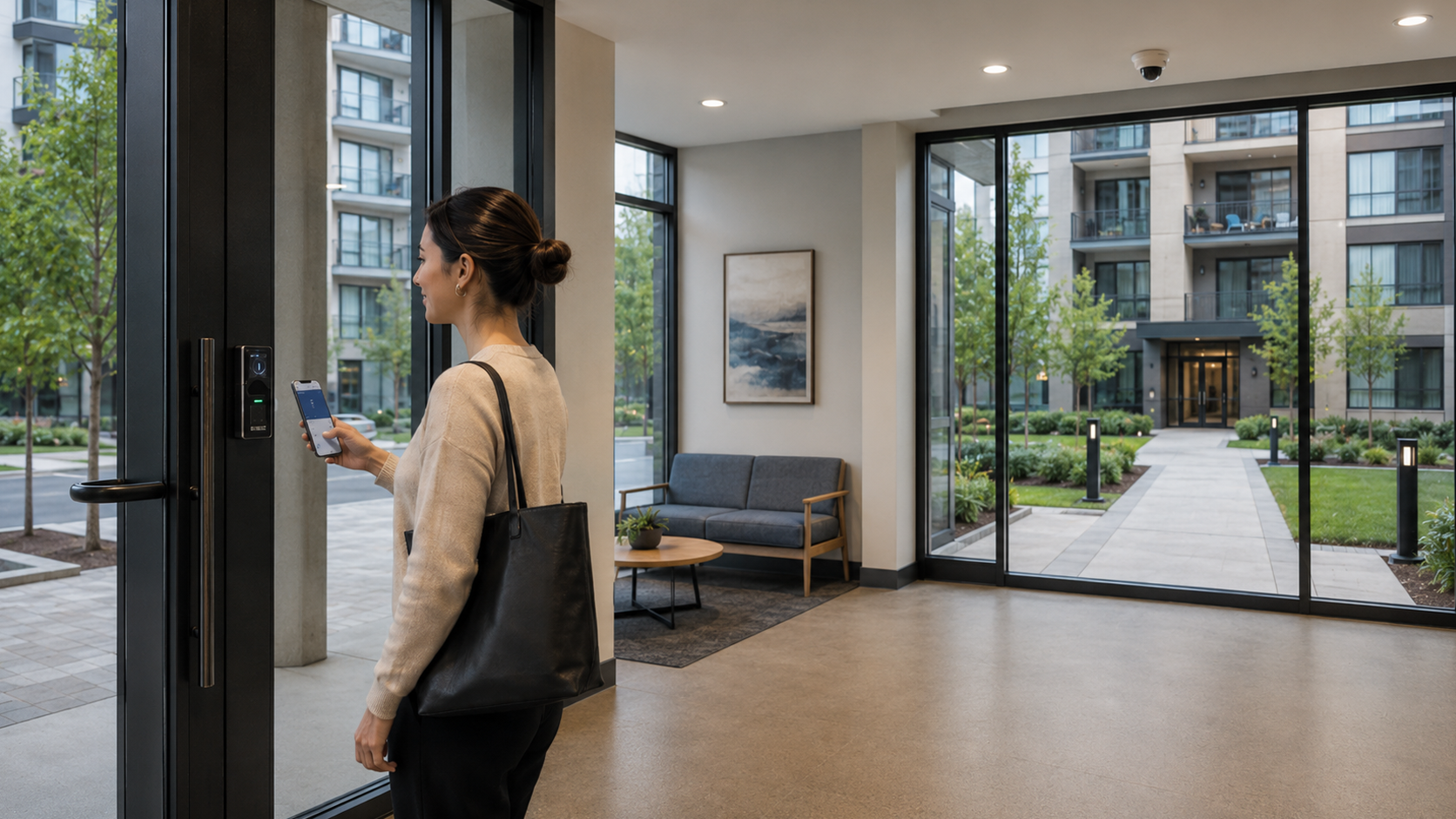
Properties with modern access control and integrated video systems report fewer negative reviews, faster unit turnover, and higher resident satisfaction scores — making security one of the highest-ROI amenity investments in multifamily today.
If you're evaluating whether smart access and video surveillance belong in your capital plan, here's what the operational data and resident behavior trends tell us.
What Residents Actually Notice During a Tour
Prospective residents evaluate more than finishes and square footage. They notice whether entry points feel controlled, whether common areas feel monitored, and whether the building communicates that management is in control. Strong security for apartment communities signals a well-run property before a lease is ever signed.
Smart access systems—cloud-connected locks, video intercoms, mobile credential entry—send an immediate signal: this property is well-run and residents are protected. That impression carries weight at lease signing. It carries even more weight at renewal.
Properties that invest in visible, modern security infrastructure consistently score higher on management quality in resident surveys, a factor that ranks in the top three drivers of lease renewal decisions according to the National Apartment Association's annual resident satisfaction research.
How Unauthorized Access Is Killing Your Online Reviews
Trespassing, package theft, and unauthorized entry are among the top complaints driving negative online reviews, and there's a direct line showing how security drives multifamily reviews and occupancy. Each incident chips away at the resident experience and your property's reputation, two things that directly affect occupancy.
The operational cost compounds quickly:
- Re-keying units after every turnover
- Managing physical fob inventories across hundreds of doors
- Responding to after-hours lockout calls
- Investigating incidents with no audit trail
A unified access control platform eliminates most of that friction. Remote credential management means turnover is faster and cleaner. Audit trails mean incidents have documented answers. Residents who can manage their own access through an app report higher satisfaction and a stronger sense of control over their home environment.
Is AI-Powered Video Surveillance Worth It for Apartment Communities?
Yes, AI-powered video surveillance is worth it, but the distinction between standard cameras and intelligent video matters significantly for cost and outcome.
Integrated video surveillance does double duty in multifamily. It deters incidents in common areas, parking structures, and entry points. It also creates a documented record when something does happen, reducing liability exposure and giving management the clarity to respond.
AI-driven analytics change what's operationally possible:
- Filter out environmental noise (wind, shadows, animals) and surface what matters
- Flag loitering at entry points or motion in restricted areas
- Alert to unusual activity in garages or package rooms
- Eliminate hours of footage review; your team responds to alerts, not recordings
For residents, well-maintained, visible cameras in common areas reinforce that the property is managed with intention. That perception of safety functions as an amenity, and amenities retain residents.
What Does Portfolio-Wide Security Standardization Actually Save?
For owners and operators managing multiple communities, fragmented security systems create measurable drag: different platforms, different vendors, different support contacts, and no cross-property visibility.
Standardizing on a single integrated platform delivers:
- Consistent resident experience across all communities
- Streamlined vendor management with one accountable partner
- Unified data — access events, video, and alarm activity feed into a single dashboard
- Proactive risk identification — see which entry points are high-traffic and which communities may need upgraded coverage before an incident surfaces
The portfolio-wide view also improves capital planning. When you can see incident patterns across sites, budget decisions are grounded in data rather than reactive to crises.
The Bottom Line: Security as an NOI Protection Strategy
Residents who feel safe stay longer. Properties that operate efficiently attract better reviews. Portfolios with standardized, intelligent security systems are easier to manage and easier to scale.
Smart access and video aren't just security tools. They're operational assets that protect net operating income, reduce turnover costs, and reinforce the value of living at your properties.
Frequently Asked Questions
Does smart access control actually reduce turnover in multifamily properties?
Yes. Properties with modern access control report higher resident satisfaction scores, fewer negative online reviews related to security incidents, and stronger lease renewal rates. The convenience of app-based credential management is itself a retention-driving amenity for residents who expect a tech-forward living experience.
What's the ROI of video surveillance for apartment communities?
ROI comes from multiple directions: reduced liability exposure from documented incident records, lower operational costs from AI-filtered alerts (vs. manual monitoring), and the retention value of a property perceived as safe and well-managed. When video and access control work together—so every door event, tailgating attempt, or after-hours entry can be quickly verified—there is a stronger case that surveillance is actively protecting net operating income, not just adding another expense.
How does centralized access control reduce property management costs?
By eliminating physical key and fob management, enabling remote credential provisioning and deactivation, and providing audit trails that resolve incidents without staff investigation time. Turnover processes become faster and cheaper when re-keying is replaced by remote credential reset.
What should multifamily operators look for in a security platform?
Prioritize platforms that integrate access, video, and alarm in a single interface; support remote management across multiple properties; provide AI-driven video analytics; and offer a single vendor relationship for installation, support, and account management. Fragmented systems create fragmented accountability.
Is it worth standardizing security systems across an entire portfolio?
For operators managing three or more communities, standardization almost always pays for itself through reduced vendor management overhead, consistent resident experience, and the ability to identify and address risk patterns across sites before they escalate.
What's the difference between a security system and a security amenity?
A security system is back-of-house infrastructure. A security amenity is visible, well-maintained, and resident-facing — app-based entry, clean camera coverage in common areas, intercoms that work. The difference is whether residents experience it as a feature of their home or an invisible utility. Properties that treat security as an amenity use it as a leasing and retention differentiator.
Vitalis Security designs, installs, and supports integrated video, access, and alarm systems built for multifamily operations. One platform. One accountable partner. Across all your communities.
Ready to see what a standardized security program looks like for your portfolio?