
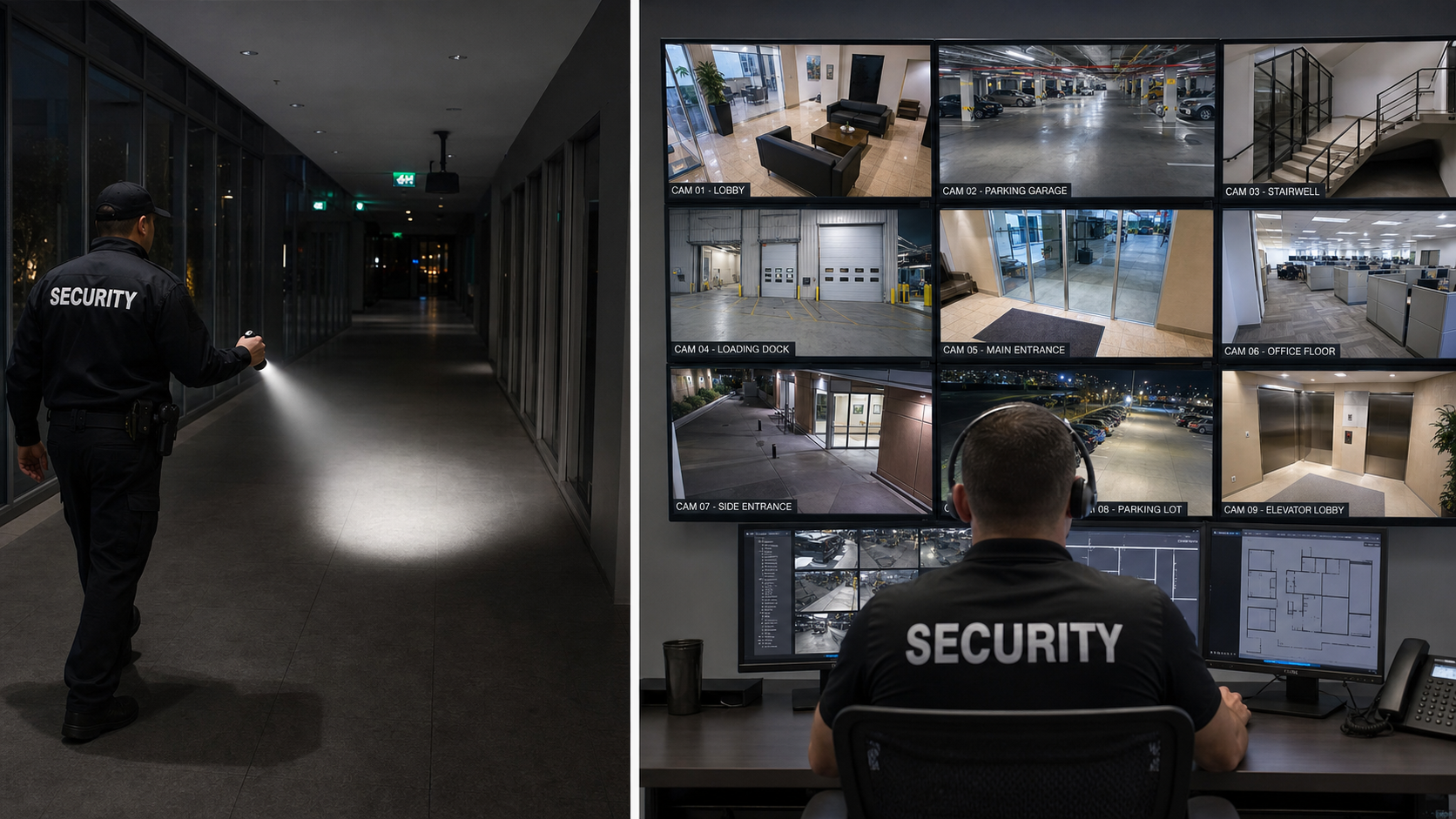
When commercial real estate operators compare overnight guards to video monitoring, the real question is not just an hourly cost. The better question is which option gives you stronger after-hours coverage, more reliable documentation, and better long-term value across the property.
For office buildings, mixed-use campuses, and multi-tenant portfolios, overnight security decisions affect more than labor budgets. They also influence how quickly incidents are detected, how well events are documented, and how much operational risk a property carries after hours. In many cases, integrated video systems with remote monitoring and intelligent analytics can provide broader overnight coverage at a lower recurring cost than guard service alone.
Why Guard Costs Alone Do Not Tell the Full Story
The true cost of overnight security includes not only guard wages, but also coverage gaps, inconsistent reporting, liability exposure, and the management burden that comes with staffing a physical post.
When operators evaluate overnight security, the conversation often starts with hourly rates. That is understandable, but it misses a bigger issue: what the property is actually getting in return. A lower hourly number does not automatically translate into stronger protection, better documentation, or better operational outcomes.
Overnight coverage is where those tradeoffs become more obvious. Empty buildings, parking structures, loading areas, and exterior access points still need to be monitored, but relying entirely on one person to patrol a large footprint creates obvious limitations. The real question is not just what overnight coverage costs, but how effectively it reduces risk.
What You Are Really Buying with Overnight Guard Service
Overnight guard service gives you a visible human presence, but it does not always deliver consistent coverage, complete documentation, or efficient monitoring across an entire property.
A traditional overnight guard can help deter activity, respond in person, and provide reassurance that someone is onsite. But one guard cannot see every entrance, parking area, stairwell, service corridor, and common space at the same time. For larger properties, that means blind spots remain even when labor costs continue to rise.
Those costs also extend beyond hourly pay. In addition to wages, benefits, and payroll taxes, operators often absorb turnover, retraining, scheduling oversight, vendor management, and liability tied to missed or poorly handled incidents. Manual reports and paper logs can also create documentation gaps that become a problem during insurance claims, tenant disputes, or litigation.
How Integrated Security Systems Change the Cost Equation
Integrated security systems change the cost equation by combining intelligent video surveillance systems, access control, alarms, and monitoring into one platform that expands overnight coverage while reducing recurring labor costs.
Instead of relying on a single guard to physically move through the property, integrated systems allow operators to monitor multiple areas at once and respond to events with more context. Cameras can watch entrances, garages, loading docks, and shared spaces simultaneously, while access control and alarm activity can trigger immediate video verification. That gives teams faster visibility into what is happening and where attention is needed.
Your draft also makes a clear financial case: a traditional overnight guard position is estimated at about $80,000 per year, while a monitored video solution is estimated at about $36,000 annually, or roughly $3,000 per month. Using those figures, the operational impact is more than $44,000 in annual savings per site, with ROI typically realized in about three months. If you publish these figures, they should be framed as a representative scenario or estimate tied to a defined property profile.
Integrated systems also provide capabilities that guard service alone often cannot match at scale:
- Continuous coverage across cameras and access points
- Real-time alerts and AI-assisted detection
- Automatic, timestamped incident documentation
- Centralized management across multiple properties
- Immediate visibility between video and access events
Pairing those cameras with 24/7 alarm monitoring with video verification means every triggered alert is confirmed before anyone is dispatched. Unlike human patrols, integrated video systems do not get tired, distracted, or pulled away from one area while something else happens in another. That consistency matters most after hours, when fewer people are onsite, and response windows can narrow quickly.
Why Integrated Systems Scale Better After Hours
Integrated systems scale better after hours because adding cameras, doors, and monitored locations increases coverage without increasing labor costs at the same rate as adding guards.
Guard coverage scales linearly. If a property needs more coverage, the typical answer is more people, more hours, and more recurring costs. That approach becomes expensive fast across larger campuses or multi-site portfolios.
Technology scales differently. Adding devices and monitored zones can expand visibility and improve response without requiring a proportional increase in staffing. It also creates more consistency, because every access event, alarm trigger, and video clip can be captured, stored, and reviewed in the same system rather than depending on handwritten notes or memory from a shift.
Where Overnight Guards Still Make Sense
Overnight guards still make sense when a property needs immediate onsite human intervention, visible deterrence, or in-person judgment that technology alone cannot provide.
This is not an argument against guards entirely. Human presence still matters in many environments, especially when properties need face-to-face interaction, physical intervention, or a clearly visible security presence. In the right context, guards remain an important part of a broader security strategy.
Guards are often most effective for:
- High-traffic lobbies and staffed entry points
- Visitor-facing areas where human interaction matters
- Situations where visible deterrence is a priority
- Environments requiring immediate onsite judgment and response
The issue is not whether guards have value. The issue is whether overnight guards are being used for tasks that integrated technology performs more reliably, such as broad-area monitoring, event detection, and continuous after-hours documentation across low-occupancy properties.
How to Evaluate the Right Overnight Security Model
The right overnight security model should be based on total annual cost, coverage quality, documentation reliability, tenant impact, and long-term operational risk.
Before you renew, it's worth stepping back to buy CRE security the right way, starting with risk rather than a product list. Operators should evaluate the full picture:
- Current annual overnight guard spending
- Existing blind spots and under-covered areas
- Quality and consistency of after-hours documentation
- Tenant expectations and satisfaction
- Liability exposure tied to delayed detection or incomplete reporting
That type of review often shows that the best answer is not choosing between guards and technology in absolute terms. It is using each where it performs best: integrated systems for broad, reliable overnight visibility and targeted onsite staffing where human presence adds the most value.
Vitalis Security helps commercial real estate operators design, install, and support integrated video, access control, and alarm systems that improve after-hours coverage and reduce unnecessary overnight guard costs. To compare guard service with monitored video at your property, request a site and cost assessment from our team.