
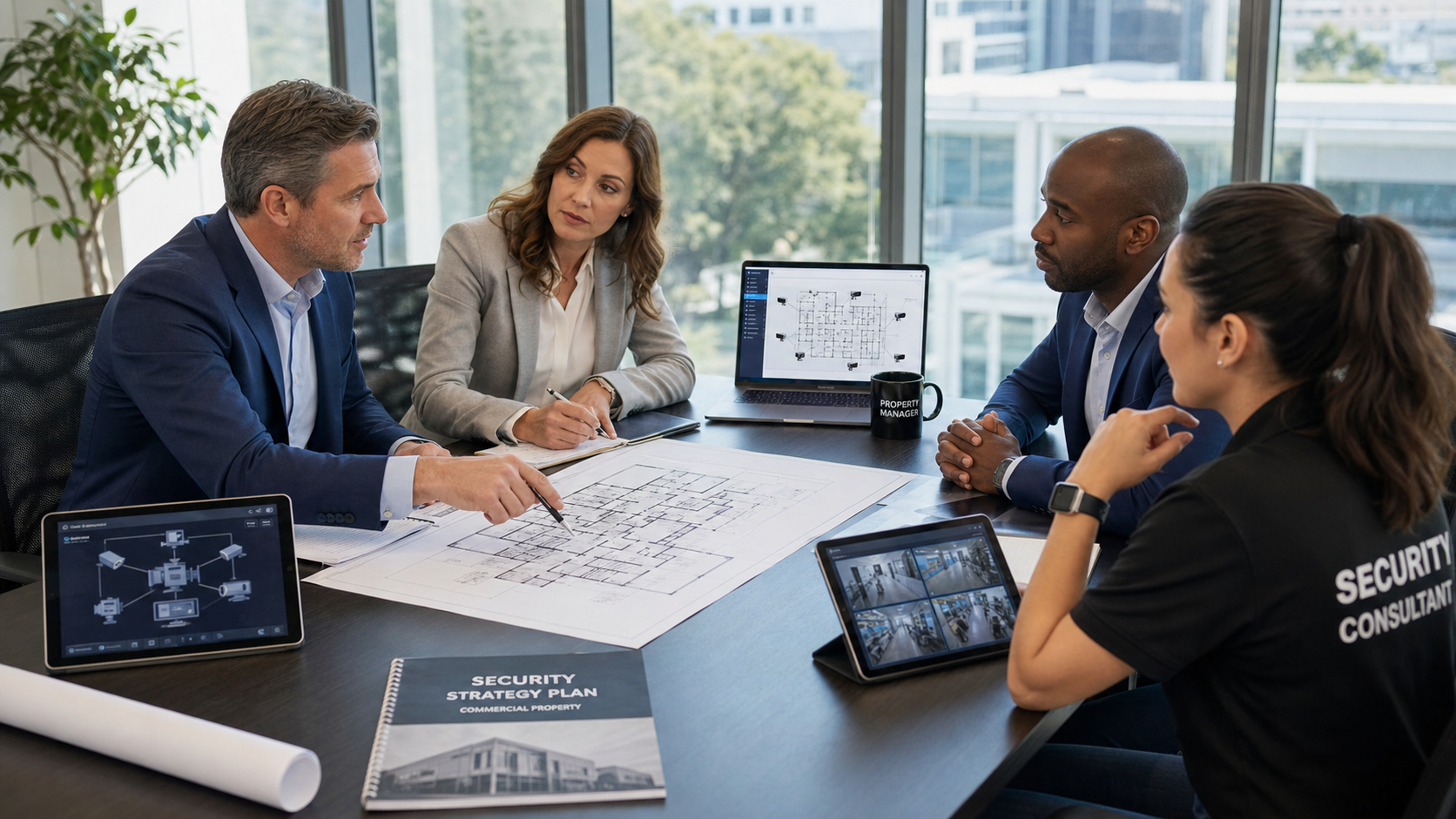
Many commercial real estate operators buy security technology first and think about strategy later, which is why so many properties end up with commercial building security systems that do not fully work together.
For commercial real estate owners and operators, security decisions are often triggered by immediate pressure, such as a break-in, a tenant complaint, a lease requirement, or inherited infrastructure that no longer fits the property. But when cameras, access control, alarms, and monitoring are purchased reactively, the result is usually a fragmented system instead of a coordinated security program. The better approach is to define your property’s risks, operational needs, and long-term goals before selecting any security technology.
Why Security Often Gets Bought Backwards
Security often gets bought backwards when technology decisions are made to solve isolated problems instead of supporting a long-term property strategy.
Walk through the history of almost any commercial property, and the pattern is familiar. Cameras were installed during construction, access control was added later for a tenant requirement, alarms came from another vendor, and monitoring contracts kept renewing without a full review. Over time, what should have been a coordinated security program turns into a patchwork of separate decisions made at different times by different stakeholders.
The issue usually is not a lack of spending. It is the order in which decisions are made. When technology is selected before the property’s actual risks and operational requirements are defined, owners often inherit complexity, duplication, and avoidable gaps.
What It Looks Like to Buy Security the Right Way
Buying security, the right way means defining what the property needs to achieve operationally, financially, and from a risk standpoint before evaluating products or vendors.
That shift changes the process immediately. Instead of asking which camera, panel, or vendor to buy first, operators start by asking how the property should function over the next several years. That includes how the site should be monitored, how incidents should be documented, how tenants should experience the property, and how the overall program should scale as needs to change.
When those priorities are established first, technology becomes a tool that supports the strategy rather than the strategy itself. That usually leads to better integration, better lifecycle planning, and fewer expensive corrections later. This is where security system design and consulting earns its keep, mapping risks and requirements before any product is selected.
Why You Should Start with Risk, Not Products
You should start with risk, not products, because every property has a different exposure profile that should determine what technology is necessary.
A downtown office tower has different security demands than a suburban mixed-use development, and both differ from a distributed multi-tenant portfolio. Location, tenant mix, operating hours, use type, staffing patterns, and incident history all shape what kind of security program makes sense. Without that context, product selection becomes guesswork.
Before evaluating systems, operators should identify the parts of the property where incidents occur most often, where coverage is weakest, where liability exposure is highest, and where tenant experience is being affected. Once those risks are clear, technology decisions become easier and more defensible.
Why Integration Should Be Planned Up Front
Integration should be planned up front because disconnected systems increase manual work, slow response times, and weaken incident documentation.
One of the most expensive mistakes in commercial real estate security is deploying systems that do not communicate with each other. When cameras, alarms, intercoms, and access control platforms all operate separately, staff have to piece together information manually. That creates operational drag on ordinary days and real exposure during serious incidents.
Integrated systems improve response because teams can see events in context. A door event can pull up the relevant camera view; an alarm can trigger immediate video verification, and incident records can be captured in a more complete and defensible way. Planning that integration before a purchase is made is far more effective than trying to retrofit it later.
Why Portfolio Standardization Creates Long-Term Value
Portfolio standardization creates long-term value by reducing complexity, improving consistency, and increasing leverage across multiple properties.
For operators managing more than one asset, learning how to standardize security across your portfolio usually creates the strongest long-term return. Using the same platforms across properties makes it easier to train teams, manage vendors, compare performance, and maintain documentation standards across the portfolio. It also reduces the friction that comes from every building running on a different stack.
Standardization can also strengthen purchasing leverage. Portfolio-level contracts, repeatable operating procedures, and scalable support relationships often lower long-term costs while improving accountability. The result is a security program that is easier to manage and easier to expand.
Why Capital and Operating Decisions Should Be Evaluated Separately
Capital and operating decisions should be evaluated separately because infrastructure lifecycle planning and ongoing service accountability are different business decisions.
Security infrastructure such as cameras, access hardware, cabling, and network components should be evaluated as capital investments over a longer lifecycle, not simply by lowest upfront cost. A cheaper system that does not integrate well or cannot scale may become more expensive over seven to ten years than a better-designed solution.
Monitoring, maintenance, and service support are different. Those are operating expenses that should be evaluated based on responsiveness, accountability, performance expectations, and how issues are tracked over time. When vendors bundle all of these choices together, operators can lose visibility into what they are actually buying and how it should be measured.
What Questions Should Guide the Buying Process
The buying process should be guided by questions about risk, coverage gaps, operational friction, auditability, and the full cost of the current security program.
Before speaking with vendors, operators should step back and ask a more strategic set of questions:
- Where do incidents consistently occur?
- What areas lack reliable coverage?
- Could the team reconstruct a complete audit trail after a major event?
- How many separate systems are required to manage security today?
- What is the true cost of the current program, including liability, staff time, and tenant impact?
- If the program were designed from scratch today, what would it look like?
The gap between those answers and the current state becomes the roadmap for improvement. That roadmap is much more useful than a list of disconnected product upgrades.
How a Forward-Looking Security Strategy Improves Outcomes
A forward-looking security strategy improves outcomes by aligning technology decisions with long-term property performance, tenant experience, and risk reduction.
Security is not just a product purchase. It is an operational system that influences how a property functions every day and how well it performs when something goes wrong. The strongest programs are usually not the ones spending the most money, but the ones making deliberate, integrated decisions before buying technology.
Operators who get the best outcomes tend to start with risk, prioritize integration, standardize where it makes sense, and choose partners who are accountable for long-term performance rather than installation alone. That is what buying security forward actually looks like.
Vitalis Security works with commercial real estate operators to design integrated video, access control, and alarm systems around property risk, operational needs, and long-term performance goals. To build a security strategy before your next technology purchase, request a free consultation with our team.